
Short answer: A duct shop needs machines for five jobs: handling and cutting the sheet, forming rectangular duct, making the joints, connecting and stiffening the sections, and making round duct and fittings. An auto duct line combines several of these steps on rectangular duct. Separate machines cover the joints, flanges, round work and special fittings, and hand-operated machines take care of short runs and repairs. Which ones you need depends on the duct you make.
How duct making machines are grouped
The easiest way to sort the types of duct making machines is by the step each one does in the shop. Coil comes in, gets flattened and cut, is formed into duct parts, gets its seams and flanges, and leaves as finished duct or fittings. Our HVAC Duct Production Line page walks through that whole sequence. This guide looks at the machine families one by one, what each one does and when a shop needs it. Our full range is on the Machines page.
| Machine family | What it does in the shop | Examples | Typical buyer |
|---|---|---|---|
| Coil handling and cutting | Unwinds coil, flattens it and cuts blanks or fitting parts | Decoiler, cut-to-length line, CNC plasma table, flange cutting saw | Any shop that buys coil, or cuts fitting blanks |
| Auto duct lines | Turns coil into rectangular duct parts in one pass | Lines with coil selector, notching, cleat forming | Shops with steady straight-duct volume |
| Lock forming and seam closing | Forms and closes the longitudinal seams | Lock former, flanging machine, seam closers, pipe lock seamer | Every rectangular duct shop |
| Flange and beading | Connects duct sections and stiffens the panels | TDF flange machine, corner machine, Z and W beading | Shops making self-flanged or larger duct |
| Round and spiral duct | Makes round duct and round fittings | Spiral duct machine, elbow machine, square-to-round converter | Shops supplying round duct systems |
| Hand-operated machines | Cuts, bends, beads and rolls sheet by hand | Guillotine shear, folding machine, beading machine, slip roll | Small shops, repairs, special fittings |
Coil handling and cutting machines
Every shop that buys coil needs a way to hold it and unwind it. A decoiler does that. Ours takes coils up to 5,000 kg and 1,500 mm wide. A cut-to-length line then flattens the strip and cuts blanks to set lengths and quantities. Fitting blanks, with their curves and odd shapes, are cut on a CNC plasma table, which can be fed straight from coil by a plasma sheet feeder. Flange profiles get cut to length on a separate saw.
Buying pre-cut sheet for mostly straight duct? Then you may need little of this at first. Once fittings become a large share of the work, a plasma table is usually the next machine a shop adds, and the whole group is on the Cutting & Coil Handling Machines page.
Auto duct lines
An auto duct line, also called an auto duct former, takes coil and turns it into rectangular duct parts in one pass. It straightens the sheet, rolls stiffening beads, cuts and folds the part under PLC control, and prepares the edges for the seam. Our four lines all handle 0.5–1.2 mm sheet at a feeding speed of 6 m/min with one operator. They differ in what they add: a 3-coil selector so a thickness change means picking another coil, hydraulic notching for self-flanged duct, and a C-cleat unit that also closes the duct lock on the line.
A line pays off when straight duct makes up a steady part of the work, because that is what it makes fastest. On our lines that is up to 800 m² in an 8-hour day without notching, and up to 650 m² with it. Elbows, offsets and transitions still go to other machines. The Auto Duct Lines page compares the four models side by side, and our guide Auto Duct Line or Individual Machines? How to Choose helps you decide whether a line fits your work.
Lock forming and seam closing machines
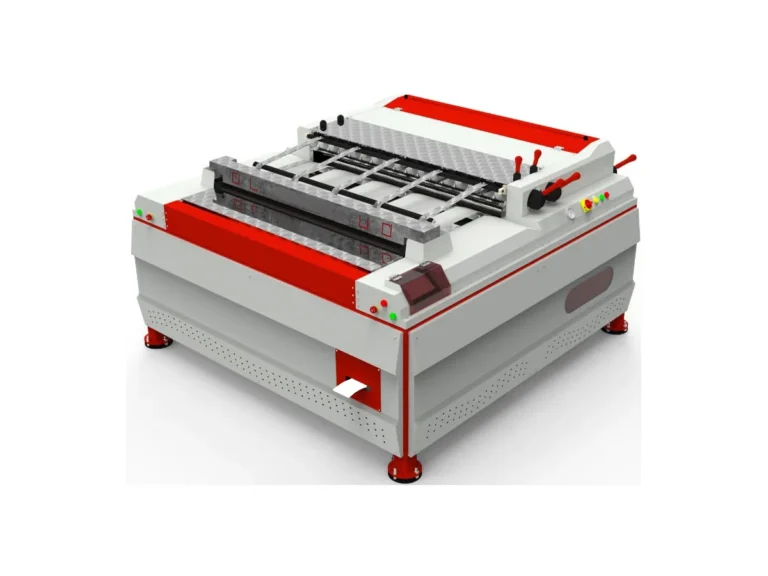
Rectangular duct is joined along its length by a lock seam, most often a Pittsburgh lock. A lock former rolls the pocket on one edge, a flanging machine bends the matching male edge, and after assembly a seam closer folds the lock shut. Round pipe rolled from flat sheet gets its own longitudinal lock and a pipe lock seamer to close it.
Almost every rectangular duct shop needs a lock former, even with an auto duct line, because fittings are made from separate parts. Our guides on the Pittsburgh lock seam and on seam closers cover these steps in detail. See Lock Forming & Seam Closing Machines.
Flange and beading machines
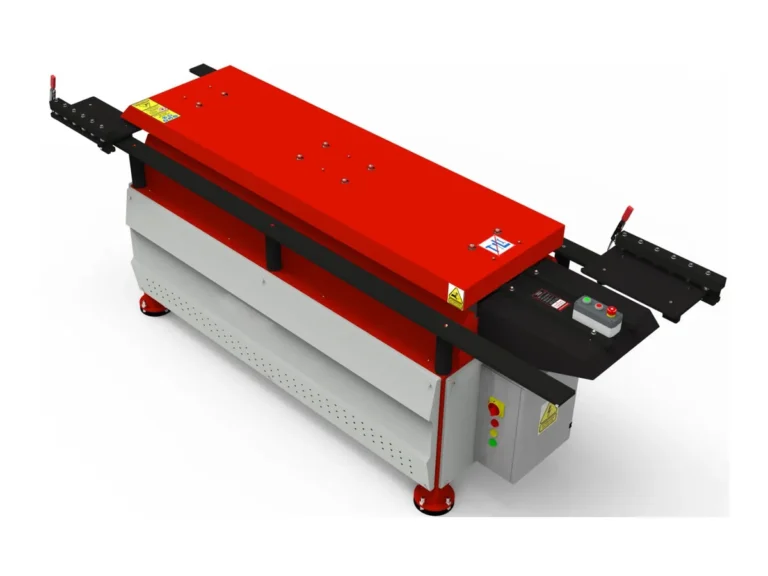
Duct sections have to connect to each other, and wide, thin panels need stiffening. A TDF flange forming machine rolls the flange straight out of the duct wall, and a corner machine presses the corner pieces into it. Ours forms 20 to 35 mm flanges, and with a roll change it also forms TDC. A C profile machine makes the profiles used to hang duct. Z and W beading machines roll stiffening beads into the sheet so wide, thin panels stay stiff (see our guide to duct beading).
The choice between a self-flanged system and separate slip-on flanges is the main decision here, and our TDF vs TDC flange guide explains it. The machines themselves are on the Flange & Beading Machines page.
Round and spiral duct machines
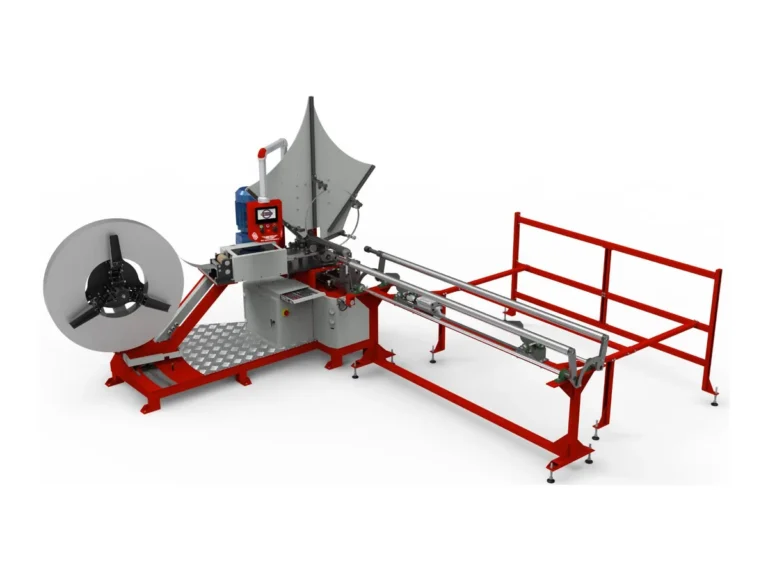
Round duct comes in two forms. Spiral duct is wound from a narrow strip with a spiral seam. Our spiral duct machine winds 137 mm strip into Ø100–1250 mm tube and cuts it to length automatically. Round pipe can also be rolled from flat sheet and locked along its length.
Round systems also need fittings. An elbow machine makes elbows, reducers and end caps, and a rectangular to round converter forms square-to-round transitions. A shop that sells round duct usually needs the spiral machine and at least the elbow machine. See Round & Spiral Duct Machines, and for the process itself, our guide How Spiral Duct Is Made.
Hand-operated machines
Some parts never justify a powered machine. Short runs, repairs, round pipe and special fittings are still made by hand on a guillotine shear, a folding machine, a beading machine and a slip roll. Our hand-operated range covers those four families, and most powered shops keep a few of them next to the production machines. See Hand Operated Machines.
Around all of this, a duct shop also needs spot welders for separate flanges, compressed air and stable power. We supply that equipment with our machines, listed under Spot Welders and Auxiliary Equipment.
Which machines does your shop need?
Start from the duct you sell. Four questions narrow the list down quickly:
- Rectangular, round or both? Rectangular duct needs lock forming and flanges. Round duct needs the spiral machine and round fitting machines.
- How much is straight duct? A steady volume of straight rectangular duct is the case for an auto duct line. A shop making mostly fittings is better served by separate machines and a plasma table.
- Which joint system? Self-flanged TDF or TDC duct needs a flange forming machine and a corner machine. Separate flanges need a flange cutting saw and spot welding.
- What power and air do you have? Our auto duct lines, lock former, duct seam closer, flanging machine and cut-to-length line run without compressed air. The plasma table, spiral machine, elbow machine, Pittsburgh seam closer and corner machine need it.
When you ask for a quote, send your duct sizes, sheet thickness range and materials, the joint and flange system you use, and your target output per day. With that, we can propose machines that fit your work.
Frequently asked questions
What are the main types of duct making machines?
Coil handling and cutting machines, auto duct lines, lock forming and seam closing machines, flange and beading machines, round and spiral duct machines, and hand-operated machines.
What machine makes rectangular duct?
An auto duct line turns coil into rectangular duct parts in one pass. A lock former, flanging machine and seam closer then make and close the seams, and a TDF flange machine forms the flanges.
What machine makes round duct?
A spiral duct machine winds strip into spiral round duct. Round pipe can also be rolled from flat sheet and closed with a pipe lock. Elbows and other round fittings come from an elbow machine.
Do I need an auto duct line to start a duct shop?
No. A shop can start with a cutting line, a lock former, a flanging machine, a seam closer and hand-operated machines. An auto duct line makes sense once straight duct volume is steady.
What information do I need for a duct machine quote?
Duct sizes, sheet thickness range and materials, the joint and flange system, the share of straight duct and fittings, and the daily output you are aiming for.