
Short answer: The walls of rectangular duct are wide, flat panels of thin sheet. Left flat, they flex as the pressure inside changes, and they can pop or drum. Rolling shallow beads into the sheet, or folding a cross-break into it, makes each panel stiffer. SMACNA’s 1995 construction standard calls for beading or cross-breaking on ducts 19 in. (483 mm) wide or more with an unbraced panel over 10 ft² (0.93 m²), in 20 gauge (1.00 mm) or thinner sheet, at pressures up to 3 in. wg (750 Pa). Beads do not replace reinforcement. The reinforcement schedule stays the same with or without them.
Why flat duct panels need stiffening
A thin flat sheet bends easily out of its own plane. In a duct, the panel sees a pressure that rises and falls with the fan and the dampers, so it moves. Sometimes it snaps from one shape to another with an audible pop, which the trade calls oil canning. Sometimes it keeps moving with the airflow and drums. A vibrating duct wall also passes sound from inside the duct into the room, and research on rectangular duct breakout noise, for example by Venkatesham, Munjal and Tiwari (2008), shows how much the wall’s own vibration matters.
Duct beading fixes most of this with shape. A sheet with ribs or folds in it resists bending far better than the same sheet left flat, the same reason corrugated sheet is stiffer than flat sheet. Beading adds no separate part. How much quieter a given duct gets has no general figure, though. It depends on the panel, the bead and the operating conditions, and a change in stiffness can shift a resonance instead of removing it.
Beading or cross-breaking?
There are two ways to shape the panel. Beading rolls straight ribs across the sheet at a set spacing. Cross-breaking folds two shallow diagonal lines from corner to corner, so the panel rises slightly into a flat X.
| Beading | Cross-breaking | |
|---|---|---|
| Shape | Parallel ribs across the panel | Two diagonal folds forming an X |
| How it is made | Rolled on a beading machine or inline on an auto duct line | Folded on a brake, panel by panel |
| Production fit | Coil-fed and repeat work | Single panels and fittings |
| SMACNA 1995 | Accepted | Accepted |
| Effect on reinforcement | None | None |
Both satisfy the SMACNA requirement. In practice, beading suits a shop that cuts sheet from coil or runs an auto duct line, because the beads go in as the sheet passes through. Cross-breaking needs a separate fold on every panel.
When SMACNA calls for beading
The 1995 edition of SMACNA’s HVAC Duct Construction Standards sets out the rule in its figure on crossbroken and beaded duct:
- Size: ducts 19 in. (483 mm) wide and larger whose unbraced panel is more than 10 ft² (0.93 m²) are beaded or cross-broken.
- Sheet and pressure: the rule applies to 20 gauge (1.00 mm) or thinner sheet at 3 in. wg (750 Pa) or less.
- Exceptions: ducts that will be covered with insulation or lined with acoustic liner are exempt. Ducts for 4 in. wg (1000 Pa) or more need no beads or cross-breaks.
- Which sides: a side needs beading only if that dimension calls for it. Not every side has to be done.
- Fittings: bead direction on fittings may be random.
The drawing shows beads at 12 in. (305 mm) spacing. Later editions may word or number these points differently, so check the edition your project specifies. In Europe, EN 1507 sets the strength and leakage requirements for rectangular sheet metal duct, and the construction method has to meet them.
Beading does not replace reinforcement
The 1995 figure states it directly: neither beads nor cross-breaks affect the reinforcement spacing schedule. A beaded panel feels stiffer in the hand, but the angles, tie rods and reinforced joints set by the construction tables for that size and pressure class all stay. Beads control flutter in the panel between reinforcements. The reinforcement keeps the duct in shape under pressure.
Bead profiles: Z, W, trapezoid and U
Z-bead, W-bead, trapezoid and U-bead are trade names for the roll profile, and the duct standards do not define them. Two machines making a “Z bead” may roll slightly different shapes. What decides how much a bead stiffens the panel is its depth, width, spacing and direction across the panel, so compare profiles by those dimensions rather than by name.
A bead is pressed into the sheet without opening it, so it leaves the duct as airtight as before. Leakage still comes from the seams and joints. We know of no published figure that puts a measurable pressure loss on standard duct beading.
Where beading happens in the shop
On a coil-fed line, duct beading is built in. Each of our auto duct lines has two stiffening units that press beads into the sheet after straightening, with two bead patterns standard and a third optional.
When sheet is cut on a separate machine, for example a cut-to-length line, a standalone beading machine adds the beads before the edges go to the Pittsburgh Lock Former.
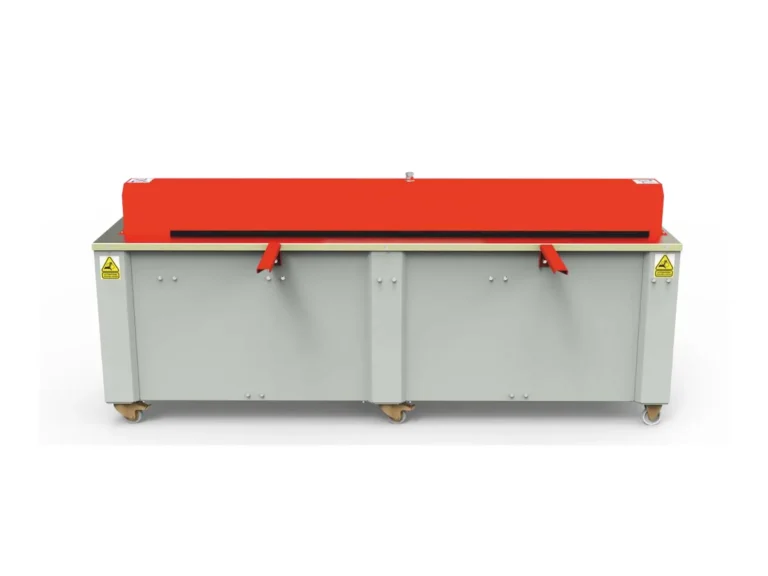
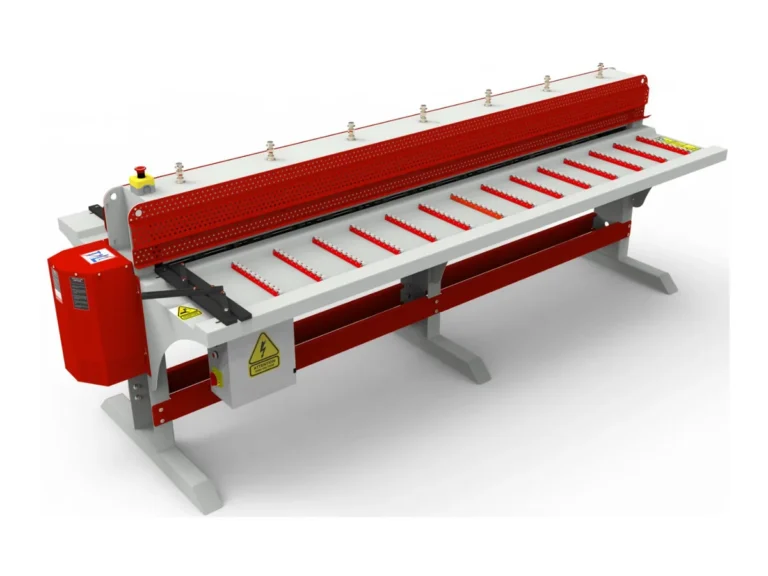
- Z Beading Machine (LPM): three working lengths, 1300, 2100 and 2600 mm, with adjustable bead spacing. It runs at 15 m/min on 0.40–1.20 mm mild steel, and forms aluminum up to 2 mm and stainless steel up to 1 mm. It runs on 220 V single-phase power.
- W Beading Machine (WBM): working widths up to 2000 or 2500 mm and three bead forms, Z, trapezoid and U. It runs at 15 m/min on 0.5–1.2 mm sheet and needs 380 V three-phase power.
Pick the LPM for adjustable spacing, single-phase power or a lighter machine. Pick the WBM if you need trapezoid or U beads or panels up to 2500 mm wide. Both are on the Flange & Beading Machines page. For the rest of the shop, see our guide to the types of duct making machines and the HVAC Duct Production Line page.
Frequently asked questions
Why are rectangular ducts beaded?
To stiffen the wide, flat panels of thin sheet so they flex less, pop less and drum less as the pressure in the duct changes.
When does a duct need beading?
Under SMACNA’s 1995 standard, ducts 19 in. (483 mm) wide or more with an unbraced panel over 10 ft² (0.93 m²) are beaded or cross-broken, in 20 gauge (1.00 mm) or thinner sheet up to 3 in. wg (750 Pa). Insulated or lined ducts are exempt.
Is beading the same as cross-breaking?
No. Beading rolls parallel ribs into the sheet, while cross-breaking folds two diagonal lines into an X. SMACNA accepts either one.
Can beading replace duct reinforcement?
No. SMACNA states that neither beads nor cross-breaks affect the reinforcement spacing schedule, so the required angles, tie rods and joints stay.
What is the difference between Z beading and W beading?
They are trade names for roll profiles. Our Z Beading Machine rolls Z beads with adjustable spacing, and our W Beading Machine forms Z, trapezoid or U beads on panels up to 2500 mm wide.
Do beads affect airflow or leakage?
Beads are pressed into the sheet without opening it, and leakage still comes from seams and joints. We know of no published figure showing a measurable pressure loss from standard duct beads.