
Short answer: An auto duct line pays off when a steady share of your work is straight rectangular duct in repeat sizes. Individual machines suit a shop whose work is mostly fittings, short runs and changing sizes. Most duct shops end up with both: a line for straight duct and separate machines for fittings, joints and flanges. No published study gives a tonnage or output figure above which a line becomes the better buy, so the decision has to come from your own production data.
What an auto duct line does, and what it leaves to other machines
An auto duct line, also called an automatic duct line or auto duct former, takes sheet from a coil and runs it through a fixed sequence under PLC control. On our lines that sequence is coil feed, straightening, stiffening beads, notching on the notching models, then cutting and folding into a flat sheet, an L-shape, a U-shape or a full square duct. A label printer marks every part for sorting on site. One operator runs the line.
The line makes straight duct parts. It does not make elbows, offsets or transitions, and on three of our four models the lock is still rolled on a lock former and closed on a seam closer afterwards. The fourth, with notching and cleat forming, closes the duct lock on the line itself. Flanges are a separate step either way: a TDF flange machine for self-flanged duct, or cut flange profiles for slip-on flanges.
So a line takes over one part of the shop. The lock forming, seam closing, flange and fitting machines stay.
The same work on individual machines
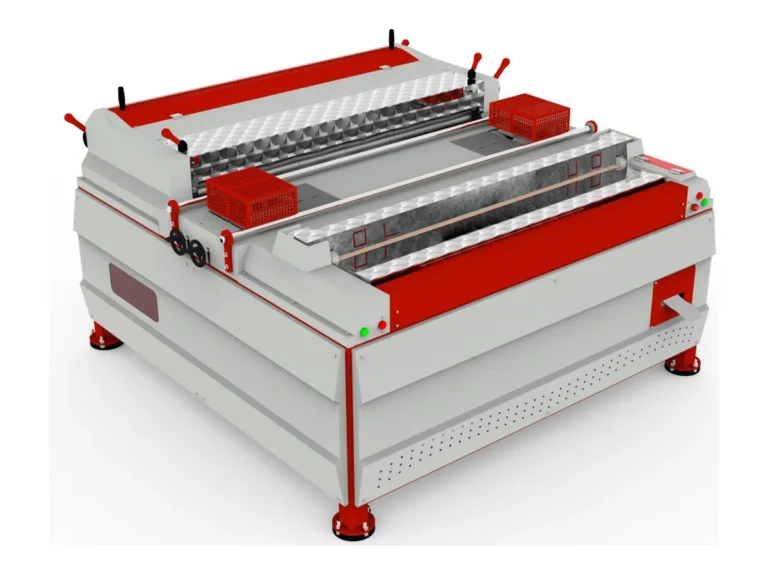
Without a line, the same steps happen at separate stations. Sheet comes from a decoiler and cut-to-length line or as pre-cut sheet, then goes through a beading machine, a shear, a folding machine, a lock former and a seam closer, with people carrying the parts from one station to the next.
That sounds slower, and for long runs of straight duct it is. Its strength is routing. A straight section, an elbow and a transition each visit only the machines they need, in their own order. HVAC duct shops work to order from changing project schedules, and Alves, Tommelein and Ballard (2005) describe exactly that kind of job shop, with product families that take different routes through the machines.
How the two compare
| Auto duct line | Individual machines | |
|---|---|---|
| Best for | Straight rectangular duct in repeat sizes | Fittings, short runs, changing sizes |
| Output | Highest on straight duct, if the steps after the line keep up | Depends on each station and on handling between them |
| Labor | One operator on the line, plus people downstream | One or more people per station, plus transport |
| Material | Coil, cut to the length each part needs | Coil or pre-cut sheet. Fitting blanks nest well on a plasma table |
| Fittings | Not made on the line | Each part takes its own route |
| Changes | Program or coil change on the line | Setup at each machine the part visits |
| Investment | One larger purchase | Machines can be bought one at a time |
| Breakdown | A stop halts the whole line | Other stations keep working |
Measure finished duct per shift
A line’s feeding speed tells you little about what the shop ships. Shipped output depends on the slowest step, and after the line come lock forming, seam closing, flanging and assembly. A fast line feeding a slow seam closer just builds a pile of parts.
Our lines run at a feeding speed of 6 m/min and reach up to 800 m² of duct in an 8-hour shift without notching, and up to 650 m² with notching, based on a 250 × 250 mm duct. Use figures like these to size the machines after the line too. Measure your own output the same way, in square meters or kilograms of accepted duct per shift, because piece counts hide the difference between a small straight section and a large fitting.
Labor and skills
One operator runs one of our lines. That is one person on the steps the line covers. Coil loading, sorting the marked parts, seam closing, flanging and assembly still need people.
The work also changes. On a line, the operator sets programs, watches the run and clears faults. On separate machines, each operator needs to know several machines and how parts move between them. The fair comparison is total labor hours per square meter of finished duct.
Coil or pre-cut sheet
A coil-fed line cuts each part to the length it needs, so the shop is not tied to fixed sheet sizes. Fittings are a different story. Their irregular blanks often nest better on flat sheet, cut on a plasma table. We know of no independent study that puts a general percentage on the material a line saves. Measure your own yield instead: the weight of accepted parts divided by the weight of material issued.
Floor space and utilities
Our lines measure 2000 × 2000 mm, or 2000 × 3000 mm with cleat forming, and the decoiler stands in front with room needed to unload at the end. They run on 380 V three-phase power and need no compressed air. Separate machines can be spread around the shop, but the space for moving and stacking parts between them adds up.
Most shops end up hybrid
The common answer is both. Straight duct runs through the line, and fittings go through a plasma table and separate machines. Plan the two streams together, because a site needs straight sections and fittings for the same installation at the same time. A shop that is not ready for a line can also start with part of the chain, such as a decoiler and a cut-to-length line, and keep forming on separate machines.
Data to collect before you decide
Before asking for quotes, pull these numbers from a few normal months of work:
- Monthly output in square meters or kilograms, and the share of straight duct versus fittings
- Duct sizes, especially the smallest (our lines start at 100 × 100 mm, the notching model at 150 × 150 mm)
- Sheet thickness range, materials and how often thickness changes
- Joint system: self-flanged duct needs notching on the line, slip-on flanges do not
- How often the same sizes repeat
- Labor hours by step, scrap and rework
- Floor space, power supply and the bottleneck in your current flow
Choosing among our auto duct lines
If a line fits your work, the choice between our four models comes down to a few questions. All four take 0.5–1.2 mm sheet at 6 m/min with one operator.
- Starting with straight duct? The Auto Duct Line Pro runs one coil at a time in 1320 or 1520 mm sheet width.
- Changing thickness often? The 3-Coil Selector keeps three thicknesses loaded.
- Building self-flanged duct? The Notching model notches the corners on the line.
- Want the most done in one pass? The Notching & Cleat Forming model adds C-cleats, closes the duct lock on the line and recalls saved programs for repeat jobs.
The Auto Duct Lines page compares them in one table. For the machines around the line, see our guide to the types of duct making machines and the HVAC Duct Production Line page.
Frequently asked questions
Is an auto duct line worth it for a small shop?
It depends on how much straight duct you make. Shop size matters less, and there is no published volume threshold. A small shop with steady straight-duct work can use a line, while a large shop making mostly fittings may get more from separate machines.
How much duct can an auto duct line make in a day?
Our lines reach up to 800 m² in an 8-hour shift without notching and up to 650 m² with notching, based on a 250 × 250 mm duct. What you ship also depends on the machines after the line.
Can an auto duct line make elbows and fittings?
No. It makes straight duct parts: flat sheet, L-shapes, U-shapes and full square duct. Elbows, offsets and transitions are made on separate machines.
How many operators does an auto duct line need?
One operator runs each of our lines. Steps after the line, such as seam closing, flanging and assembly, need their own people.
Does an auto duct line replace the lock former and seam closer?
Our Notching & Cleat Forming line closes the duct lock on the line, so it needs no separate seam closer for straight duct. With the other three lines, the lock is rolled on a lock former and closed on a seam closer afterwards. Fittings still need a lock former either way.