
Short answer: Spiral duct is made from a narrow strip of sheet metal fed from a coil. Rolls shape both edges of the strip, a forming head set at an angle winds it into a tube, and each new turn locks into the edge of the turn before it. Compression rolls press that joint into a continuous spiral lock seam, and a cut-off unit cuts the tube to length. One spiral duct machine does all of it.
Spiral duct fabrication, step by step
- Coil and strip. The machine takes a coil of narrow strip. Strip width is set by the machine’s forming geometry, so there is no single industry width. Our spiral duct machine runs on 137 mm strip.
- Edge forming. Rolls bend both edges of the strip into matching hook profiles, one to sit inside the other.
- Winding. The strip enters a forming head at an angle and follows a helical path, so it comes out as a round tube. The tooling sets the diameter, and the angle of the strip to the head sets the pitch of the spiral.
- Locking the seam. As each turn meets the previous one, the two edge profiles hook together and compression rolls flatten them into a lock. Unlike a Pittsburgh lock on rectangular duct, the seam needs no separate closing step later.
- Cutting to length. A cut-off unit separates the tube at the set length while the tube keeps coming.
- Checking. Sections are checked for diameter, roundness, a fully closed seam and clean ends before they go to fittings or to site.
The spiral lock seam
SMACNA’s HVAC Duct Construction Standards lists the spiral seam as seam type RL-1 for round duct, next to lap seams, welded seams, the grooved seam (pipe lock) and snap lock seams. In the 1995 edition, the seam table allows RL-1 up to +10 in. wg (2500 Pa) positive and −10 in. wg (−2500 Pa) negative pressure. The grooved seam is held to −3 in. wg (−750 Pa) under negative pressure, and snap lock seams appear only in the lowest pressure classes.
The exact profile of the lock varies from machine to machine. Terms like flat lock or standing seam are used in the trade, but they are not a formal classification of spiral duct seams in the standard. What matters is simple. The lock has to be fully engaged and pressed along the whole spiral.
Spiral duct vs longitudinal-seam round duct
Round duct can also be made from a flat blank, rolled into a cylinder on a slip roll and closed with a straight lock along its length. The 1995 SMACNA commentary states no preference between the two seam types.
| Spiral duct | Longitudinal-seam round duct | |
|---|---|---|
| Starting material | Narrow strip from a coil | Flat sheet blank |
| Seam | Continuous spiral lock (RL-1) | Straight lock along the length, such as a pipe lock (RL-5) |
| How it is made | Wound and locked in one pass, cut to length | Rolled, then the seam is locked and closed |
| Section length | Cut to any length the machine allows | Set by the size of the rolling equipment |
| Negative pressure (1995 seam table) | RL-1 up to −10 in. wg | Grooved seam up to −3 in. wg |
| Typical machine | Spiral duct machine | Slip roll plus pipe lock seamer |
Sizes, sheet thickness and pressure
Spiral duct comes in a wide range of diameters, and the right sheet thickness depends on the diameter, the pressure class and whether the duct runs under positive or negative pressure. The SMACNA commentary notes that round duct for positive pressure can generally have a thinner wall than duct for negative pressure. Larger diameters deform more easily under suction, so they need more wall or stiffening. Take the gauge for each diameter from the construction tables your project follows. In Europe, EN 1506 covers the dimensions of circular ducts and EN 12237 their strength and leakage.
Some manufacturers also roll corrugations, or ribs, between the lock seams so that a thinner wall can be used. The 1995 commentary mentions this form as new to the industry at the time.
Is spiral duct stronger or tighter?
Round duct in general has a high strength-to-weight ratio and is comparatively easy to seal, which is one reason it is used so widely. Claims that a spiral seam makes duct measurably stiffer or tighter than a longitudinal seam of the same gauge are harder to back up. The test data is thin. We know of no controlled test that proves a general advantage either way.
What the evidence does show is that most leakage in a duct run comes from the transverse joints between sections. In a laboratory study of round and rectangular duct, Aydın and Özerdem (2006) measured most of the leakage at the joints, with the seams contributing less. Longer sections mean fewer joints. A 12 m straight run built from four 3 m sections has three joints, while two 6 m sections have one. In practice, section length is limited by the fittings in the run, the risk of damage in shipping, handling on site and the number of supports needed.
Joining and sealing spiral duct
Slip or lap joints are the most common way to connect round duct sections. A coupling slides into or over the two ends, is fastened, and is sealed with sealant or a gasket. The 1995 SMACNA commentary notes that flanged joints are used on ducts over 60 in. (1524 mm) in diameter, because the flange helps keep the duct round.
The spiral lock holds the tube together. Sealing is a separate job, set by the project’s seal class. SMACNA applies the same seal classes to round duct as to rectangular duct.
Making spiral duct with our machines
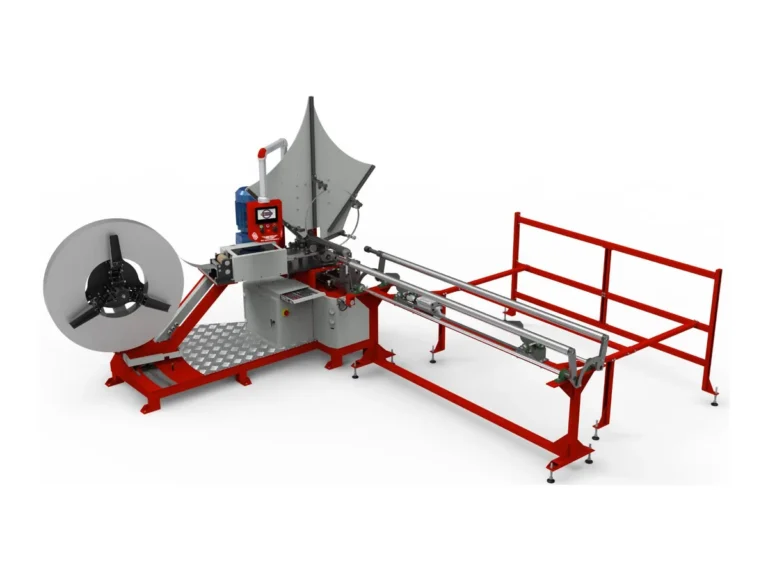
Our Spiral Duct Machine (STF) winds 137 mm strip into spiral round duct from Ø100 to Ø1250 mm, with tooling for 23 standard diameters, and cuts each tube to a set length from 250 to 6000 mm. It runs from a PLC touch screen on 0.5–1.2 mm coated sheet or 0.4–0.7 mm chrome sheet. Speed depends on diameter: 14 m/min at Ø100, 2.8 m/min at Ø500, 1.4 m/min at Ø1000 and 1.2 m/min at Ø1250. It comes with its own coil holder for 750 kg coils and needs 380 V three-phase power and 6–8 bar compressed air.
Straight duct is only part of a round system. The Round Duct Elbow Machine (see our guide to round duct elbows) builds gored elbows, reducers and end caps from Ø125 to Ø1250 mm, and the Rectangular to Round Converter forms square-to-round transitions. For round pipe with a straight seam, the Pipe Lock Seamer closes the longitudinal lock. All of these are on the Round & Spiral Duct Machines page. How round and rectangular production fit together is shown on the HVAC Duct Production Line page, and our guide to the types of duct making machines covers the rest of the shop.
Frequently asked questions
How is spiral duct made?
A narrow metal strip is fed from a coil, its edges are roll-formed into matching hooks, and a forming head winds it into a tube at an angle. Each turn locks into the previous one, compression rolls close the spiral seam, and the tube is cut to length.
What is a spiral lock seam?
It is the continuous seam that runs around spiral duct, formed by hooking the edges of neighboring strip turns together and pressing them flat. SMACNA lists it as round duct seam type RL-1.
What strip width is used for spiral duct?
It depends on the machine’s forming geometry, so there is no single standard width. Our spiral duct machine uses 137 mm strip for its whole diameter range.
How long can spiral duct sections be?
The machine can cut any length within its range, 250 to 6000 mm on ours. In practice, length is limited by fittings in the run, shipping, handling on site and the number of supports needed.
What pressure can spiral duct take?
In the 1995 SMACNA seam table, the spiral seam is permitted up to 10 in. wg (2500 Pa), positive or negative. The sheet thickness for each diameter and pressure class comes from the construction tables of the standard your project uses.
Does spiral duct need sealing?
Yes, when the seal class calls for it. The spiral lock is a mechanical seam, and most leakage in a duct run comes from the joints between sections, so couplings and joints are sealed with sealant or gaskets.