
Short answer: Most round duct elbows are gore elbows, also called segmented elbows. They are built from several short round pieces, called gores, each cut at an angle and locked to the next at a circumferential seam. Together the angled joints turn the air through 90°, 45° or any angle in between. SMACNA ties the number of pieces to air velocity: a 90° elbow takes 3, 4 or 5 pieces, and a 45° elbow 2 or 3, with a longer radius as velocity rises. In the shop, an elbow machine, often called a gore locker, forms the gore edges and locks the seams.
What a gore elbow is
Picture a round duct sliced at an angle into short pieces and turned piece by piece. Each joint between two gores changes direction by an equal share of the total angle. A 90° elbow in five pieces has four joints, so each joint turns the air 22.5°. More pieces give a smoother curve.
Gore elbows are one of several kinds. SMACNA’s HVAC Duct Construction Standards shows segmented, segmented standing-seam, stamped, pleated and adjustable round elbows. A stamped elbow is pressed into a smooth curve in dies. A pleated elbow gets its bend from many small folds in the wall. An adjustable elbow has sections that can still turn, so the angle is set on site. Gore elbows suit a wide range of diameters and radii, because each one is built from flat patterns instead of fixed tooling.
How gores are cut and joined
- Lay out the elbow. Diameter, bend angle, centerline radius and number of pieces set the pattern for each gore.
- Cut the blanks. The flat patterns are cut from sheet, for example on a CNC plasma table, with allowance for the seams.
- Roll each gore. Every blank is rolled into a short round piece and its own longitudinal seam is closed.
- Form the edges. The angled ends are flanged or formed into matching profiles so neighboring gores can lock together.
- Lock the seams. Rotating rolls close each circumferential joint all the way around. This step is what a gore locker does.
- Check and seal. The finished elbow is checked for angle, roundness and fully closed seams, then sealed where the specification asks for it.
Locking is not the only way to join gores. SMACNA also lists welded or brazed fittings, tack or spot welded fittings, and riveted or screwed fittings, each sealed or unsealed as specified. On thin galvanized sheet, a mechanical lock is the usual choice.
How many gores does an elbow need?
SMACNA’s Table 3-1 sets the number of mitered pieces by the velocity of the air in the duct. Where no other limit is stated, mitered elbows are built to this table.
| Duct velocity | Centerline radius to diameter (R/D) | 90° elbow | 60° elbow | 45° elbow |
|---|---|---|---|---|
| Up to 1000 fpm (about 5 m/s) | 0.6 | 3 pieces | 2 pieces | 2 pieces |
| 1001 to 1500 fpm (about 5 to 7.6 m/s) | 1.0 | 4 pieces | 3 pieces | 2 pieces |
| Above 1500 fpm (about 7.6 m/s) | 1.5 | 5 pieces | 4 pieces | 3 pieces |
Two points are easy to miss. The table counts pieces, not joints, so a five-piece elbow has four seams. And the standard’s 90° drawings do not rule out other angles, so a 30° or 60° elbow follows the same logic. A project specification can always ask for more pieces or a longer radius than the minimum.
Radius, gore count and pressure loss
Turning the air costs pressure. A tight radius forces a sharp turn and more turbulence, while a longer radius lets the air bend gradually. That is why the table asks for both more pieces and a larger R/D at higher velocity.
For design numbers, engineers use loss coefficients for the exact fitting from the ASHRAE Duct Fitting Database. A single coefficient does not fit every gore elbow. It changes with radius, number of pieces, diameter and air speed, and measured values for a particular elbow can differ from the database figure. Two elbows placed close together also affect each other. Their combined loss depends on how far apart they are and how they are turned relative to each other.
Sealing gore seams
A gore elbow has more possible leak paths than a straight duct section: the circumferential joints between gores, the longitudinal seam inside each gore, and the connections at both ends. SMACNA’s seal classes apply to round duct and fittings just as they do to rectangular duct.
A locked gore seam holds the elbow together mechanically. Sealing is a separate step. Sealant goes on the joints wherever the seal class requires it. More gores mean more joints to seal. We know of no study showing that leakage rises in step with gore count. What matters most is how well each joint is closed and sealed.
Common gore elbow defects
- Wrong overall angle: small cutting or assembly errors that add up over several joints.
- Out-of-round gore: distortion while rolling or handling before the seam is locked.
- Open or partly closed lock: edge profiles that don’t match, or a closing pass that missed part of the circumference.
- Cracked flange or seam: sheet too hard or too thick for the bend, or a seam formed twice.
- Twisted elbow: gores locked out of line with each other.
- Seam projecting into the airflow: a poorly closed lock that adds resistance inside the elbow.
- Scratched coating: dirty or damaged forming rolls.
Check the first elbow after any change of diameter, sheet or tooling, and measure the angle and roundness before the batch runs.
Making round elbows with our machines
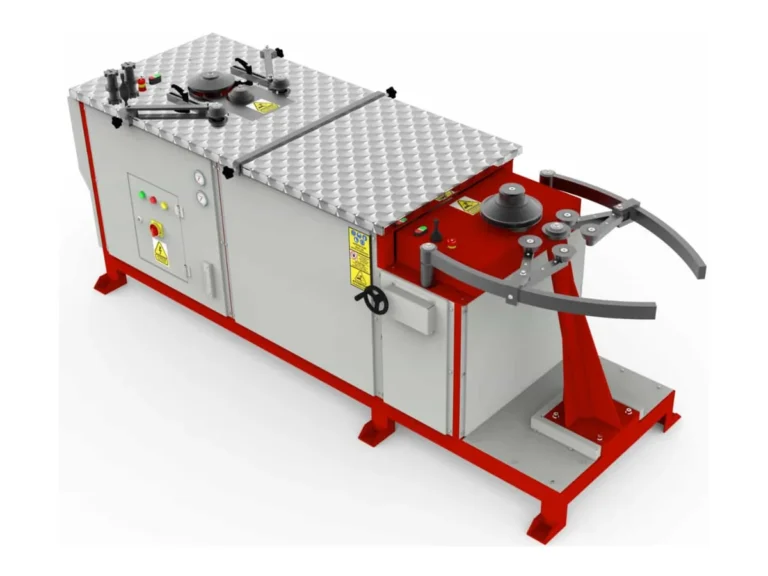
Our Round Duct Elbow Machine (EMM) flanges the segments of gored elbows and closes their seams, and it makes reducers and end caps the same way. It covers Ø125 to Ø1250 mm, with an adapter set for Ø100–125 mm, on 0.5–1.5 mm galvanized and 0.5–1.0 mm stainless sheet, with flange heights of 5, 7.5 or 10 mm. It has two stations, one for flange preparation and one for closing, so two operators can work at the same time. A Ø200 mm 90° elbow in four segments takes about 2 minutes. It runs on 380 V three-phase power with 6–8 bar compressed air.
Gore blanks can be cut on our CNC Plasma Cutting Table, and the Pipe Lock Seamer closes the longitudinal lock on round pipe. Straight runs come from the spiral duct machine (see How Spiral Duct Is Made), and square-to-round transitions from the Rectangular to Round Converter. The whole group is on the Round & Spiral Duct Machines page, and the full shop flow on the HVAC Duct Production Line page.
Frequently asked questions
What is a gore elbow?
A round duct elbow built from several short round pieces, called gores, cut at an angle and locked together at circumferential seams. It is also called a segmented or mitered elbow.
How many gores does a 90° elbow have?
SMACNA Table 3-1 calls for 3, 4 or 5 pieces depending on air velocity: 3 pieces up to 1000 fpm, 4 pieces up to 1500 fpm and 5 pieces above that. A five-piece elbow has four seams.
What is a gore locker?
A shop name for the machine that forms the edges of elbow gores and locks the seams between them. Our Round Duct Elbow Machine does this from Ø125 to Ø1250 mm.
What R/D ratio should a round elbow have?
SMACNA Table 3-1 sets a minimum centerline radius of 0.6, 1.0 or 1.5 times the diameter, rising with air velocity. A longer radius lowers the pressure loss.
Do gore elbow seams need sealing?
Yes, when the seal class calls for it. The lock holds the elbow together, but each circumferential joint, the seam in each gore and the end connections are possible leak paths.
What is the difference between a gore elbow and an adjustable elbow?
A gore elbow is locked at a fixed angle in the shop. An adjustable elbow has sections that can still rotate, so the installer sets the angle on site.