
Short answer: TDF (transverse duct flange) and TDC (transverse duct connector) are both self-flanged connections for rectangular duct. The flange is roll-formed from the duct wall itself instead of being added as a separate frame. Both go together the same way, with corner pieces, bolts at the corners, clips along the sides and a gasket between the flanges. Only the shape of the flange profile differs, so corners, clips and forming rolls have to match the system you build.
What a transverse joint has to do
Rectangular duct is made in sections, and each section is joined to the next one across the duct. The transverse joint holds those sections together and keeps them aligned while the duct hangs from its supports. It also stiffens the duct end, where a thin, wide panel would otherwise flex under air pressure, and it has to seal well enough that the connection does not turn into the main leakage path.
Four joint types cover most rectangular duct. TDF and TDC roll the flange out of the duct sheet. A separate slip-on flange profile is fixed to a plain duct end. Steel angle-iron frames take the heavy end of the range, and slip-and-drive cleats the small, low-pressure ducts.
TDF vs TDC: two profiles of the same idea
In self-flanged duct the sheet is cut slightly larger than the duct face. The extra material at each end runs through a roll former and becomes the flange. Nothing is welded or riveted on.
TDF and TDC share that principle and the same assembly steps. They differ in the cross-section of the flange profile, and the exact dimensions vary from one system and supplier to the next. The names are not used the same way everywhere either. SMACNA lists both as formed-flange transverse joints (T-25a and T-25b), but some suppliers and markets also call a separate slip-on profile “TDC”. Check the profile drawing before you order corners and clips. Corner pieces made for one profile will not seat in the other, and the clips have to match the profile they close. Forming tooling is profile-specific too. A machine built for TDF needs a set of TDC rolls before it can form TDC.
Which one a shop builds usually comes down to the market and the project: the system local contractors install, the corners and clips they can buy nearby, and what the specification asks for.
Self-flanged duct vs other transverse joints
| TDF / TDC (self-flanged) | Slip-on flange profile | Angle-iron flange | Slip-and-drive cleats | |
|---|---|---|---|---|
| How the flange is made | Roll-formed from the duct wall | Separate profile, cut to length and fixed to the duct end | Separate steel angle frame fixed to the duct end | S-slips and drive cleats formed from sheet |
| Extra parts | Corners, clips, gasket, bolts | Profile, corners, clips, gasket, bolts, plus sealing at the flange-to-duct seam | Angle, bolts, gasket | Cleats only |
| Production | Well suited to automated lines | Extra cutting and fixing step | Most manual work | Simple forming |
| Assembly speed | Fast | Fast once the flange is fixed | Slower | Fast |
| Typical use | Commercial rectangular duct | Repair and low-volume work, or shops without flange-forming equipment | Large, heavy or high-pressure duct | Smaller, low-pressure duct |
Self-flanged duct removes a whole production step. There is no flange profile to cut, slide over the duct end and fix, because the flange comes off the roll former as part of the sheet.
How a TDF or TDC joint is made and assembled
- Notching. Before the sheet is folded, the corners are notched so the flanges on each face can meet cleanly. On an automatic duct line this happens inline.
- Flange forming. The edges of the sheet run through a roll-forming machine that shapes the flange profile.
- Closing the duct. The duct is folded and the longitudinal seam is closed.
- Corner pieces. A corner piece goes into each of the four flange corners. This can be done by hand with a hammer or by a corner inserting machine.
- Joining on site. Two duct sections meet flange to flange with a gasket between them. They are bolted at the corners and held along each side by clips.
How tight the joint is depends on the whole assembly. Corner sealing, gasket compression, clip spacing and the longitudinal seam all count, and a badly seated corner is a typical leakage path.
TDF flange dimensions: sheet thickness and flange height
Self-flanged connections are typically formed on galvanized duct sheet of roughly 0.5–1.2 mm. That is a common forming range, not a limit set by any standard. Very large or high-pressure ducts may call for thicker sheet, closer reinforcement or angle-iron frames, depending on the construction tables the project uses.
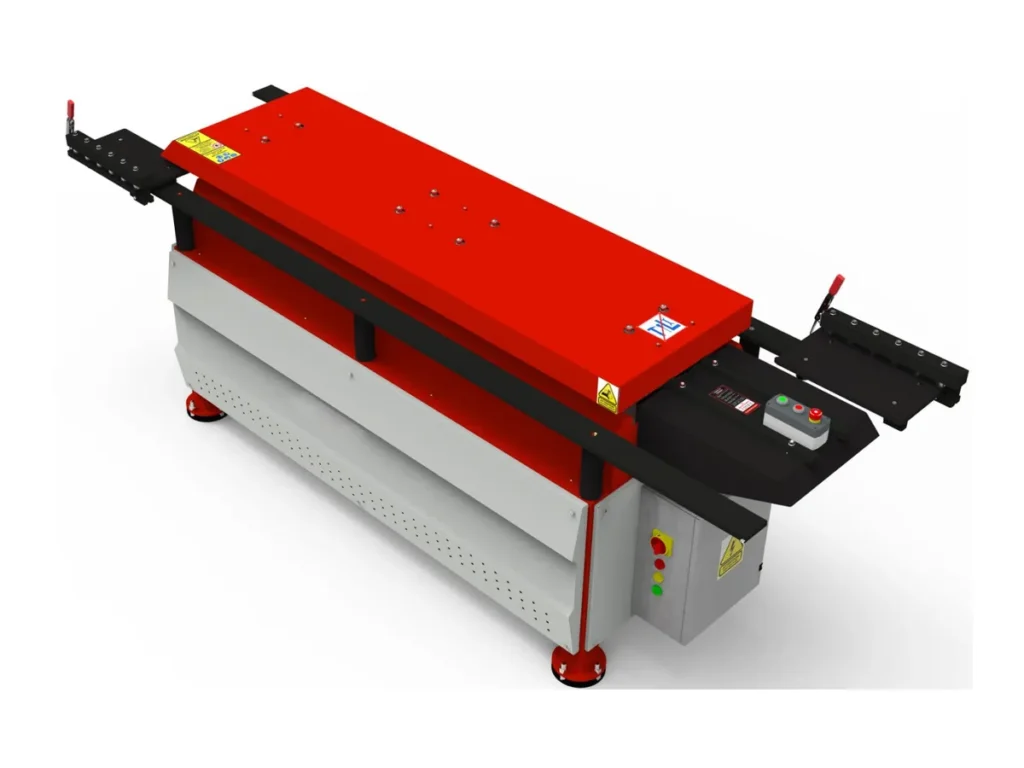
Larger and higher-pressure ducts may need a deeper flange profile. Which flange height goes with which duct size, pressure class and sheet thickness comes from the construction standard the project follows, not from the flange name itself. On our TDF Flange Forming Machine, TDF duct flange heights of 20, 25, 30, 33 and 35 mm are all standard, and the machine switches between them automatically.
Pressure, leakage and standards
Duct construction standards set how transverse joints are selected for a given pressure, duct size and sealing requirement. The main ones are SMACNA HVAC Duct Construction Standards, Metal and Flexible in the USA, BESA DW/144 Specification for Sheet Metal Ductwork in the UK, and EN 1507 in Europe, which covers strength and leakage requirements for rectangular sheet metal air ducts. DW/144 and EN 1507 grade airtightness in leakage classes A to D, with D the tightest.
There is no simple rule such as “TDF equals leakage class C”. A well-built self-flanged duct can meet strict leakage requirements, but the result depends on the complete assembly: duct size, flange profile, clip spacing, gasket, corner sealing and workmanship, and testing where the project requires it. The same is true for slip-on and angle-iron flanges.
Producing TDF and TDC flanges in your shop
TDF ducting starts with notched sheet, then the flange is rolled on, and finally the corners go in. Here is how that maps to our machines.
- Notching: the Auto Duct Line with Notching and the Auto Duct Line with Notching & Cleat Forming do all the notching that self-flanged duct needs.
- Flange forming: the TDF Flange Forming Machine has a 14-station roll forming line for 0.50–1.20 mm sheet at 8 m/min. Its second tooling side forms the connecting clips, and with a roll change it also forms TDC flanges, so you do not need a separate TDC flange machine.
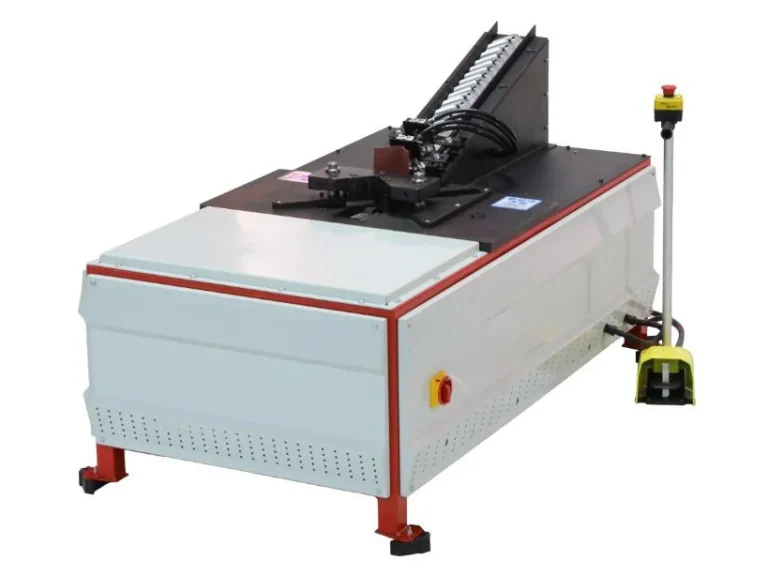
- Corners: the TDF Corner Machine inserts and presses the corners into TDF and TDC flanges from an automatic magazine, at the press of a foot pedal.
- Slip-on flanges instead: if you build duct with separate flange profiles, the Flange Cutting Machine cuts them to length.
Sheet thickness values are given for ST37 (S235JR) mild steel. All machines and their specifications are on the Flange & Beading Machines page, and the full sequence from coil to finished duct is on the HVAC Duct Production Line page.
Frequently asked questions
Is TDC the same as TDF?
They work the same way. Both are flanges roll-formed from the duct wall and assembled with corners, clips, bolts and a gasket. The flange profiles differ, so corners, clips and forming rolls are not interchangeable. Some suppliers also use “TDC” for a separate slip-on profile, so check the drawing.
Is a TDF flange better than a slip-on flange?
It depends on the duct. Self-flanged duct needs fewer parts and fewer steps and suits automated production. Separate slip-on profiles suit repair work, low volumes and shops without a flange forming machine. A slip-on flange is not automatically weaker or leakier. Both have to meet the same construction and leakage requirements.
Can one machine make both TDF and TDC flanges?
Yes, if it takes both roll sets. Our TDF Flange Forming Machine forms TDF flanges as standard and TDC duct flanges with a roll change.
What flange sizes are used on TDF duct?
It depends on duct size and the construction standard. Our TDF machine forms 20, 25, 30, 33 and 35 mm flange heights as standard.
Do TDF ducts need gaskets?
Yes. A gasket between the flanges is part of the joint, together with corner sealing, to keep leakage low.
How are the corners fitted?
By hand with a hammer, or with a corner inserting machine such as our TDF Corner Machine, which places each corner from a magazine and presses it into the flange.